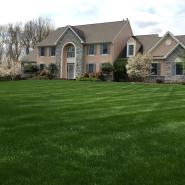

Lawn Tech offers lawn care services to maintain lush lawns and to restore lawns that become weak and thin.
Not all of these services may be necessary on your lawn.
 |
Fertilization Slow release fertilizers applied spring, summer and fall to strengthen the root system and help resist against insects and diseases. |
 |
Crabgrass Pre-emergent Applied Mid-March to late April (weather permitting). Prevents crabgrass from germinating later in the summer. There is at least a 90% control for crabgrass depending on weather conditions. Thin lawns will have less of a control. |
 |
Broadleaf Weed Control Applied spring and fall to control broadleaf weeds such as dandelion, plantain, clover etc... Controls broadleaf weeds present in the lawn at the time of application. |
|

|
Preventative Grub Control Prevents grubs (the larvae stage of many types of beetles) from damaging your lawn later in the summer and fall. It is applied late spring or early summer. It may be done at the same time as your summer fertilization. |
|

|
Surface Feeding Insect Control Helps control surface feeding insects such as chinchbugs, armyworms, etc.. |
|

|
Disease Control Timely applications for lawn diseases such as red thread, dollar spot, summer patch, etc... |
|

|
Nutsedge Control Controls nutsedge that is present at the time of the application. the appearance of nutsedge resembles grass, though it is actually a sedge. the coarse, light green leaves grow faster and taller than the surrounding grass. Nutsedge grows vigorously in the summer, especially under moist conditions; primarily troublesome in closely mowed lawns.
|
|

|
Soil Test We recommend sending a soil sample to an independent lab for exact pH readings and lime recommendations. There may be a nominal fee for this service. |
|
Lime Apply limestone to regulate the soil's pH. A soil test should be performed and sent to a lab to see if lime is needed. The price of lime and the amount required is based on the soil test.
|
|

|
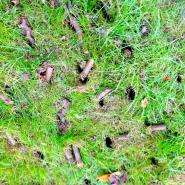
Plug Core Aeration Using both walk behind and tow behind hollow tine aerators, 1" to 3" inch deep plugs of soil are pulled out of the turf (plugs remain on the lawn and decompose in about four weeks). Core aeration will help reduce thatch buildup and relieve soil compaction allowing grass to grow deeper roots and make better use of water and fertilizer. With repeated aeration (recommended every fall), over time the lawn will show enhanced heat and drought stress tolerance. This will improve your lawn's health and appearance.
|
|

|
Slit Seeding First the lawn is aerated. Then a slit seeding machine is used to insert seed into the soil that was just loosened and then slices the seed into the soil. More seed to soil contact means a higher germination rate and a better stand of new grass. This process also dethatches the lawn by removing dead root and grass matter, which is removed when and where heavy.
|
|

|
Tick and Flea Control Program* This program consists of 3 timely applications (Spring, Late Spring and Fall) during the year to help control the Northern Deer Tick and the American Dog Tick. The tick's habitat is "normally" leaf litter, landscaping beds, tall grassy areas and/or the underbrush of wooded areas. *We recommend all three applications for adequate suppression of ticks. Keep in mind that ticks are transported to your property by several kinds of animals throughout the year. This program does not guarantee total elimination of ticks.
|